
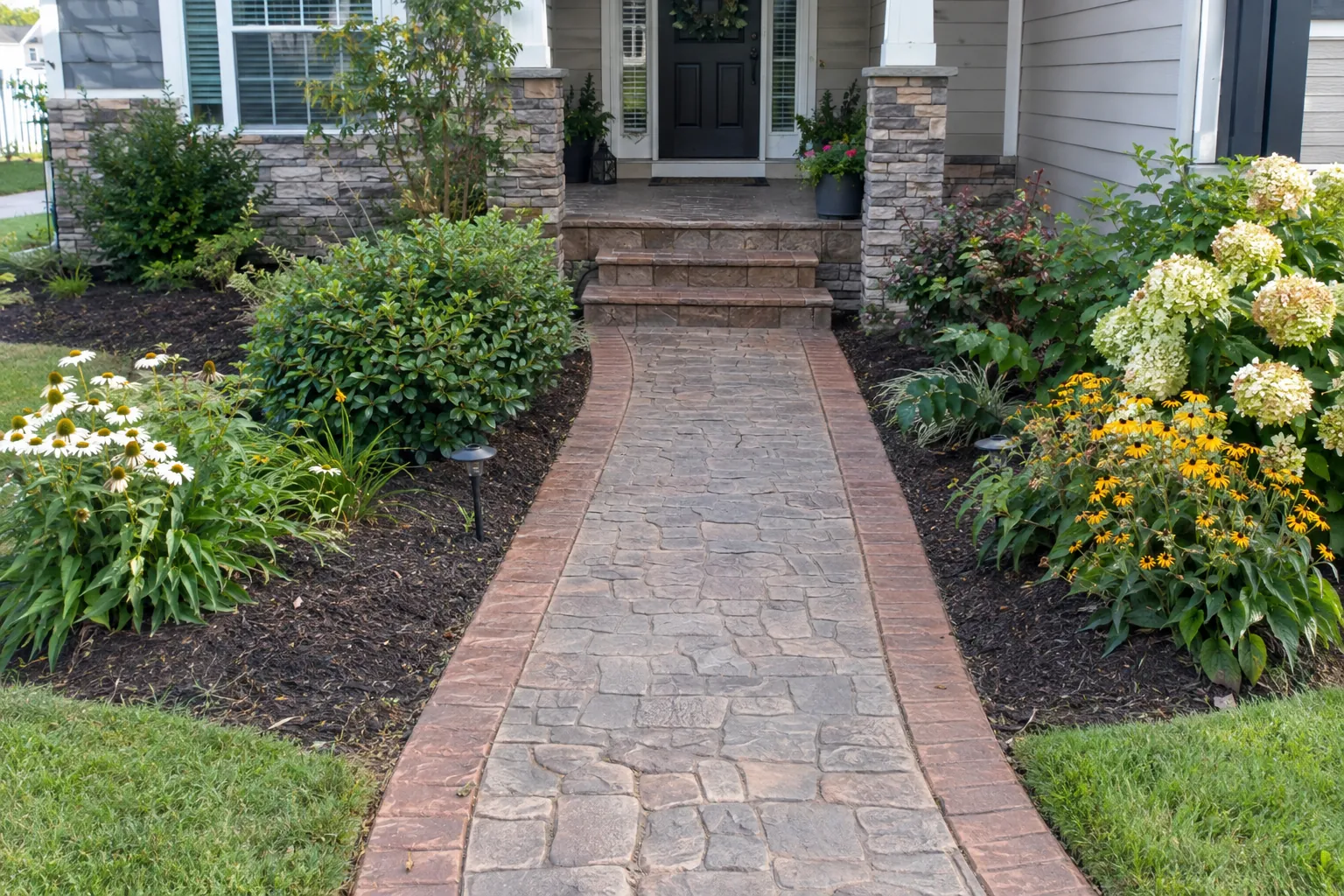
Clarksville Concrete Works installs stamped concrete, colored concrete, concrete staining, and exposed aggregate on Clarksville patios, walkways, pool areas, and driveways. Decorative concrete gives you the look of stone, slate, brick, or wood with the strength of one poured slab.
How Stamped Concrete Is Made
The slab is poured like any patio, on a compacted crushed-stone base with reinforcement. Color goes in one of two ways: integral color mixed at the plant, or a dry-shake color hardener troweled into the fresh surface. A powdered or liquid release agent goes down next. It keeps the stamp mats from sticking and leaves a darker accent color in the texture.
While the concrete is still plastic, the crew presses polyurethane stamp mats, from manufacturers such as Brickform and Proline, into the surface in sequence so the pattern lines up. Edges and corners are finished with flexible "flopper" mats and texture skins. Timing is everything: too early and the pattern slumps, too late and it won't take a clean impression. After curing, the surface is washed and sealed with an acrylic sealer, often with a non-slip additive.
Popular Stamped Concrete Patterns in Clarksville
- Ashlar slate: mixed rectangular stone, the most popular patio pattern
- Random stone and flagstone: natural, irregular joints
- Cobblestone and European fan: common for driveway borders and walks
- Wood plank: weathered boards, popular around fire pits
- Running bond and herringbone brick: borders and front walks
Most patterns look best with two tones: a base color and a darker release color in the grout lines. We bring color charts and sample photos to the estimate.
Stamped Concrete Patios
A stamped concrete patio is the most common decorative project we pour. Borders in a contrasting pattern, like a slate field framed by a brick soldier course, make a patio look custom without much added cost. Stamped patios get the same base, thickness, and joints as any concrete patio; the decoration happens on top.
Stamped Concrete Driveways
A stamped concrete driveway makes a big first impression, but it takes more care than a broom finish. Driveways carry tires, oil, and winter slush, so we usually recommend stamping a border, apron, or walkway and leaving the drive lanes broom-finished or colored. If you want the whole driveway stamped, we pick a pattern with shallower texture and seal it with a non-slip additive. See concrete driveways.
Colored Concrete and Concrete Staining
Integral color
Pigment is mixed through the whole batch, so chips and wear don't reveal gray concrete underneath. It's the most durable way to color exterior concrete.
Acid stain and water-based stain
Acid stain reacts with the lime in cured concrete to create mottled, variegated tones. Water-based stain gives a wider color range and more predictable results, and works well for recoloring existing slabs.
Exposed Aggregate
A surface retarder is sprayed on the fresh concrete, and a few hours later the top layer of cement paste is washed off to reveal the stone in the mix. The result is a textured, slip-resistant surface that hides dirt and tire marks, a strong choice for pool surrounds, steps, and sloped walks.
Stamped Overlays on Existing Concrete
If your existing slab is solid but plain or worn, a stamped overlay can add pattern and color without tear-out. A thin polymer-modified cement layer is applied and stamped with the same mats. See resurfacing & sealing.
Stamped Concrete vs. Pavers
Stamped concrete usually costs less up front and has no joints for weeds and ants. Pavers can be lifted and replaced one at a time. Both hold up in Middle Tennessee freeze-thaw cycles when installed on a proper base, but stamped concrete needs resealing every two to three years to protect color and surface.