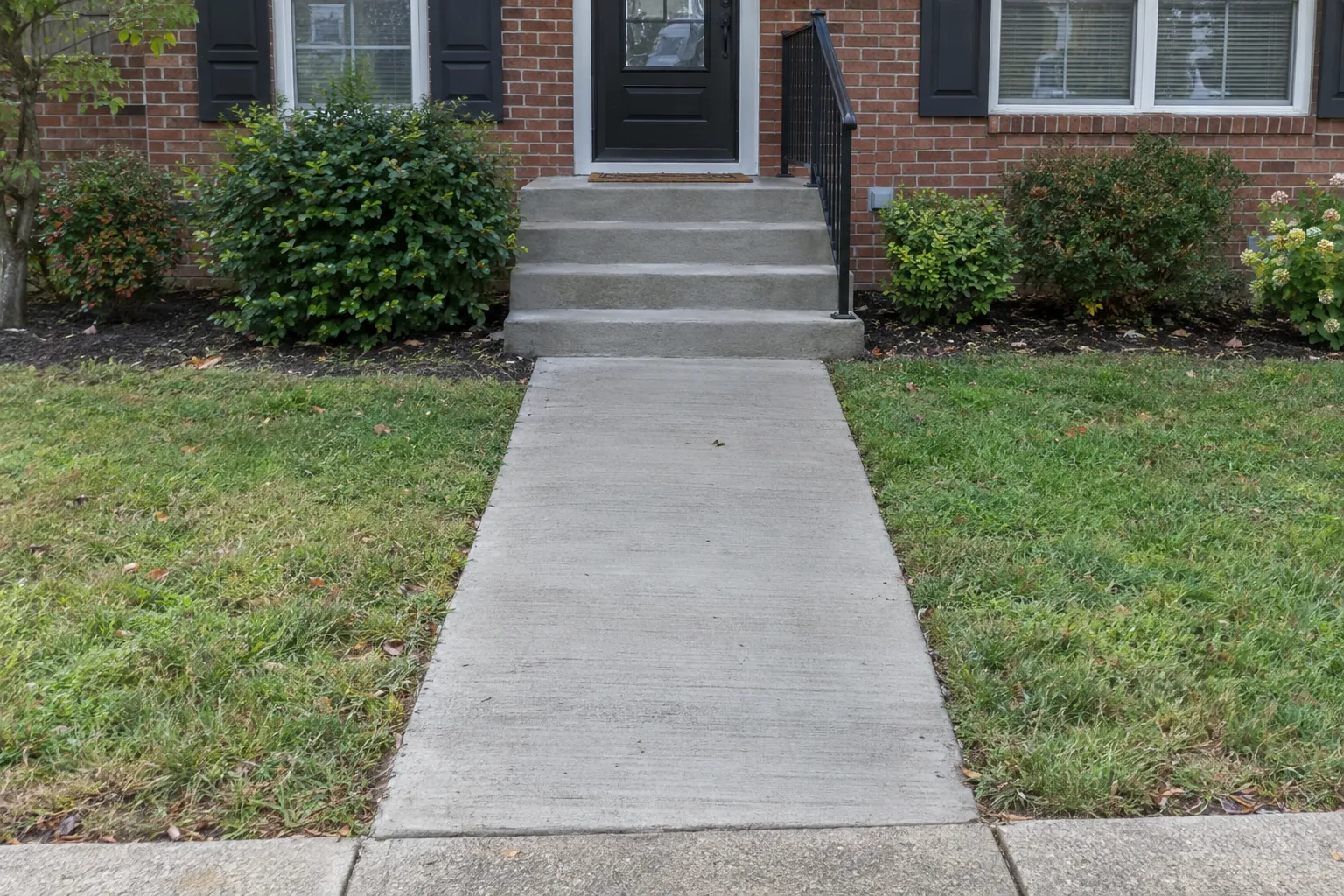
Clarksville Concrete Works builds and replaces poured concrete steps, front stoops, concrete porches, walkways, and sidewalks across Clarksville. Steps that have pulled away from the house and sidewalk panels that heaved into trip hazards are safety problems as much as eyesores, and they're usually the first thing a guest notices.
Concrete Steps and Stoops
Built to a consistent rise
Poured concrete steps are formed on site to fit your entry. Good steps have the same riser height and tread depth all the way up, because an uneven step is the one people trip on. Building codes limit how tall each riser can be (commonly no more than about 7 3/4 inches for homes) and require handrails past a certain number of risers. We lay the run out before forming so the top step lands where it should at the door.
Footings and reinforcement
Concrete steps sit on footings below frost depth or on a deep compacted base, and they're tied together with rebar and pinned to the foundation where appropriate, so they don't separate from the house as Clarksville clay shrinks and swells. Steps that sit on loose fill are the ones that tilt away from the door after a few years.
Repair or replace?
Small chips and narrow cracks can be patched, and broken nosings rebuilt. Concrete steps that have pulled away from the house, sunk on one side, or crumbled at the edges usually need to be broken out and rebuilt. See concrete repair for smaller fixes.
Concrete Porches
A concrete porch slab is poured with a slight slope away from the door and finished to match the walkway, or upgraded with stamped or colored concrete for a more finished entry. On raised porches, the slab sits on block or poured foundation walls with fill compacted in lifts underneath.
Walkways and Garden Paths
Front walks are typically 3 to 4 feet wide, though 4 to 5 feet lets two people walk side by side. Walks are poured 4 inches thick on a compacted base with joints every 4 to 5 feet. Paths can curve through a yard to a patio, shed, or back gate, and a walkway from the driveway to the front door is one of the cheapest upgrades to a home's curb appeal.
Concrete Sidewalks and Sidewalk Repair
Sidewalks heave from tree roots, sink where soil washed out, and crack from freeze-thaw. A raised edge of an inch or more can trip someone. Damaged panels can be saw-cut out and replaced individually, and tree roots under a lifted panel can be cut back before the new section goes in. Responsibility for sidewalks along the street varies, so we check with the City of Clarksville before any public sidewalk repair is scheduled.
Finishes for Safety
A broom finish is the standard non-slip surface. Exposed aggregate grips even better in rain, and stamped finishes should be sealed with an anti-slip additive. A slight cross-slope keeps water from pooling and freezing on walks and steps in January.
Handrails
Steps with several risers need a sturdy handrail. We set rail post sleeves or anchors in the concrete during the pour, or core into existing steps, so the railing installer has a solid mount.