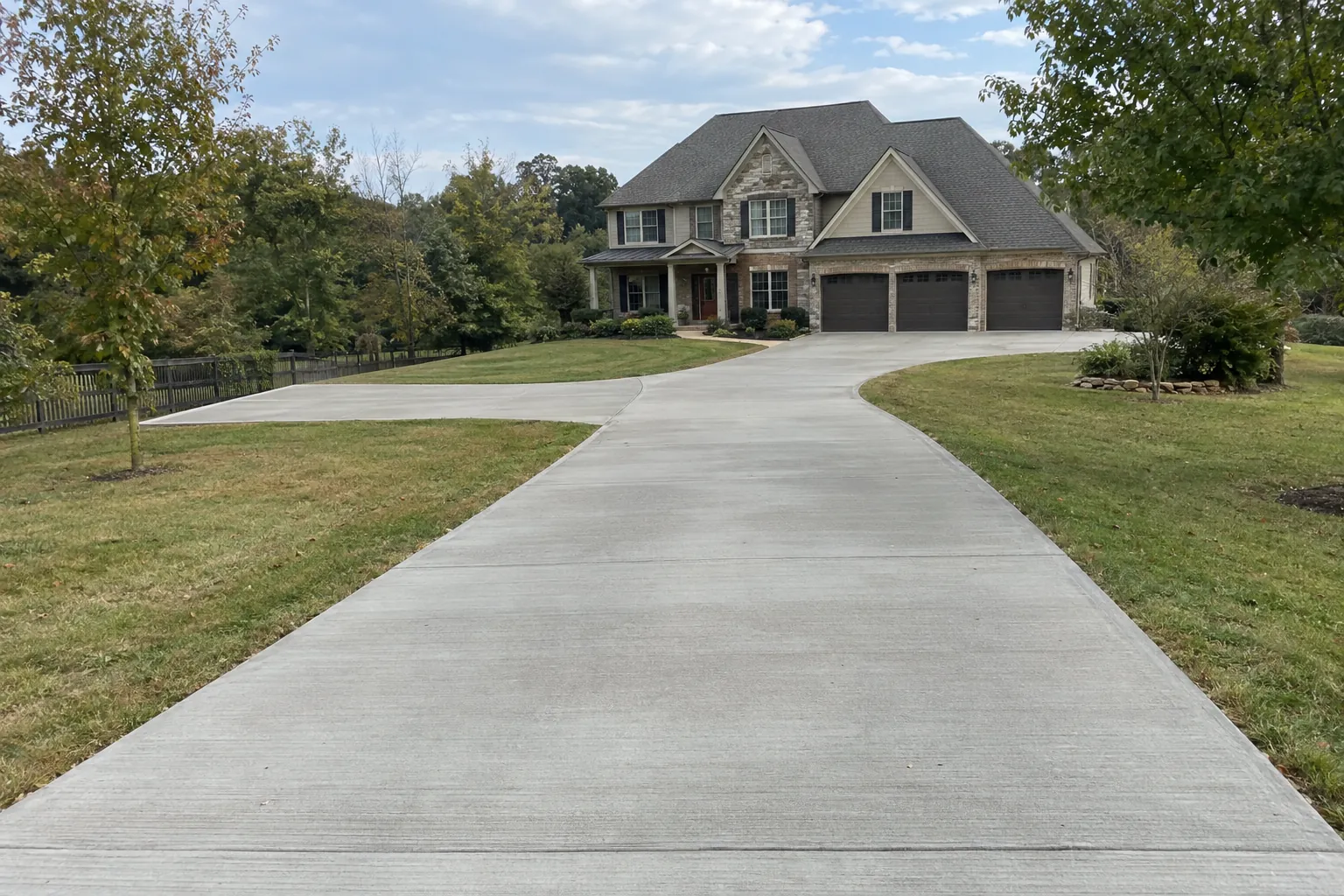
Clarksville Concrete Works installs new concrete driveways and replaces failing ones across Clarksville, from single-car drives in older neighborhoods to long rural driveways out toward Woodlawn and Cunningham. We measure, check drainage and soil, and give you a written quote with every spec on paper.
New Concrete Driveway Installation
A driveway that lasts in Clarksville starts below the surface. The crew strips topsoil and soft clay, then places 4 to 6 inches of crushed limestone base and compacts it in lifts. Forms are set with a slight fall, usually about 1/8 to 1/4 inch per foot, so water drains toward the street or yard and away from the garage. Reinforcement goes in next, either #3 or #4 rebar on chairs or 6x6 welded wire mesh, then the concrete is placed, screeded, bull-floated, edged, and broom-finished.
Driveway Replacement
Signs it's time to replace
- Cracks wider than about 1/4 inch, or cracks that keep growing - Sections that have sunk, tilted, or heaved so edges no longer line up - Scaling and spalling where the surface flakes off after salted winters - Water that pools on the slab or runs toward the house
Repair or replace?
Narrow cracks and surface damage can be fixed with concrete repair. When the slab is broken into many pieces, the base has washed out, or a third or more of the surface is failing, replacement is usually the better value.
How replacement works
The old driveway is broken up, loaded, and hauled to a recycler, where it's crushed for reuse. We inspect what was underneath, often bare clay with no stone base, digs out soft spots, installs and compacts new base, then forms and pours the new driveway. Most replacements run a few days from tear-out to pour.
Driveway Thickness and Concrete Mix
Cars and SUVs
4 inches of concrete on a compacted base.
Pickups, trailers, and RVs
5 to 6 inches where heavy vehicles park, with thickened edges where tires roll on and off.
Mix design
Most crews order 4,000 psi ready-mix with 5 to 7 percent entrained air for freeze-thaw durability, sometimes with synthetic fibers added to reduce surface cracking.
Driveway Aprons and Curb Cuts
The apron is the section between your driveway and the street. It takes the most abuse from turning tires and is the part most often cracked. A new apron or curb cut that ties into a city street can need approval from the City of Clarksville or Montgomery County, and we check before scheduling.
Finishes and Upgrades
A broom finish is standard: slip-resistant and the least expensive. Popular upgrades include a stamped or colored border (a cobblestone or brick border is a common choice), an exposed aggregate finish, widening for a second or third car, a side parking pad for a boat or trailer, and a turnaround on long rural drives. See stamped & decorative concrete.
Curing, Joints, and Sealing
Control joints are tooled or saw-cut within hours of the pour, typically every 8 to 12 feet on a 4-inch driveway, so shrinkage cracks follow straight lines. The slab is cured with water or a curing compound so the surface doesn't dry out too fast. Plan on about 7 days before driving on it, and about 28 days before applying a penetrating silane or siloxane sealer that helps it resist oil, water, and road salt.
Cleaning, Oil Stains, and Care
Sweep and rinse regularly, and treat oil and fluid drips quickly with a concrete degreaser before they soak in. A penetrating sealer makes stains easier to clean and protects against road salt. Avoid rock salt the first winter, and use plastic shovel blades to protect the surface.
Planning Your Budget
Driveway cost depends on square footage, thickness, base work, finish, and whether an old driveway has to be removed first. See our concrete driveway and patio cost guide, or compare concrete vs. asphalt driveways.