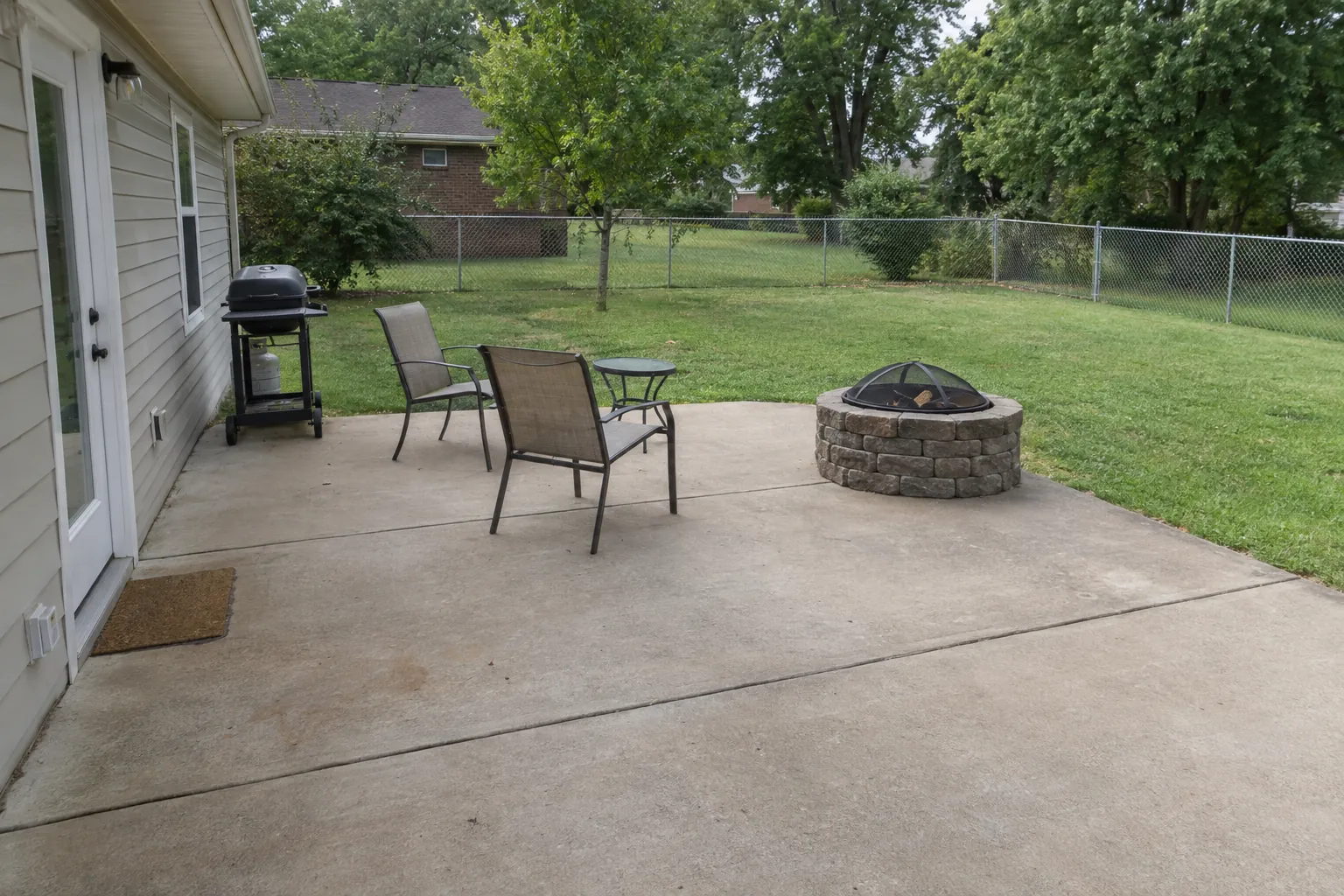
Clarksville Concrete Works builds concrete patios for Clarksville backyards, from a simple slab off the back door to a large entertaining space with a grill pad, seating wall, and fire pit area. We help you size it, choose a finish, and give you a written quote that lists every spec.
Planning Your Concrete Patio
Size and shape
Think about how you'll use the space. A table for six with chairs pulled out needs roughly 12 by 12 feet. Add a grill station and a walkway around it and most families land somewhere between 300 and 500 square feet. Curved edges and rounded corners cost a little more in forming but often look better than a plain rectangle.
Where it meets the house
A patio poured against the house needs an isolation joint where it meets the foundation, so the two can move independently, and it has to sit below door thresholds and siding. We check those heights before we set a single form.
Steps and transitions
Many Clarksville yards drop off behind the house. A patio paired with poured concrete steps, or a short retaining wall on the low side, turns an awkward slope into usable space.
Drainage Comes First
A concrete patio has to slope away from the house, usually about 1/8 to 1/4 inch per foot. In Clarksville's clay soils, water that collects against a foundation causes bigger problems than any patio crack. If your yard slopes toward the house, we may add a channel drain, extend downspouts, or adjust the grade before the patio is poured. A patio that holds water in low spots is almost always a grading mistake, and it's far cheaper to get right before the pour than to fix after.
How We Build a Concrete Patio
Base
We strip topsoil and soft clay, then place and compact 4 inches or more of crushed stone. This is the step that keeps the patio from sinking at the edges.
Thickness and reinforcement
Most patios are poured 4 inches thick with rebar or welded wire mesh, thicker under a hot tub, outdoor kitchen, or masonry fire pit.
Control joints
Joints are cut or tooled every 8 to 10 feet on a 4-inch slab, laid out to look intentional, so shrinkage cracks follow straight lines instead of wandering across the surface.
Mix and cure
We use an air-entrained mix for freeze-thaw winters and cure the slab properly, which matters most when a summer pour sits in full sun.
Patio Finishes
Broom finish
Plain, slip-resistant, and the most affordable.
Stamped concrete
Patterns that look like flagstone, slate, brick, or wood plank. See stamped concrete.
Colored and stained
Integral color mixed through the concrete, or acid and water-based stain applied after it cures.
Exposed aggregate
A textured surface that shows the stone in the mix. It hides dirt and grips well when wet.
Grill Pads, Fire Pits, and Covered Patios
A dedicated grill pad keeps grease off the lawn and gives you a level spot for a smoker. Fire pit areas can be poured as a ring around a masonry pit. If you plan to add a pergola or patio cover later, tell us at the estimate so we can thicken the slab at the post locations or set footings now.
Concrete Patio Extensions
If you already have a small slab, it can usually be extended. The new section is doweled to the old one or separated with an expansion joint. Matching the color of old concrete exactly is hard, so many homeowners use the extension as a chance to add a stamped or colored border that ties both together.