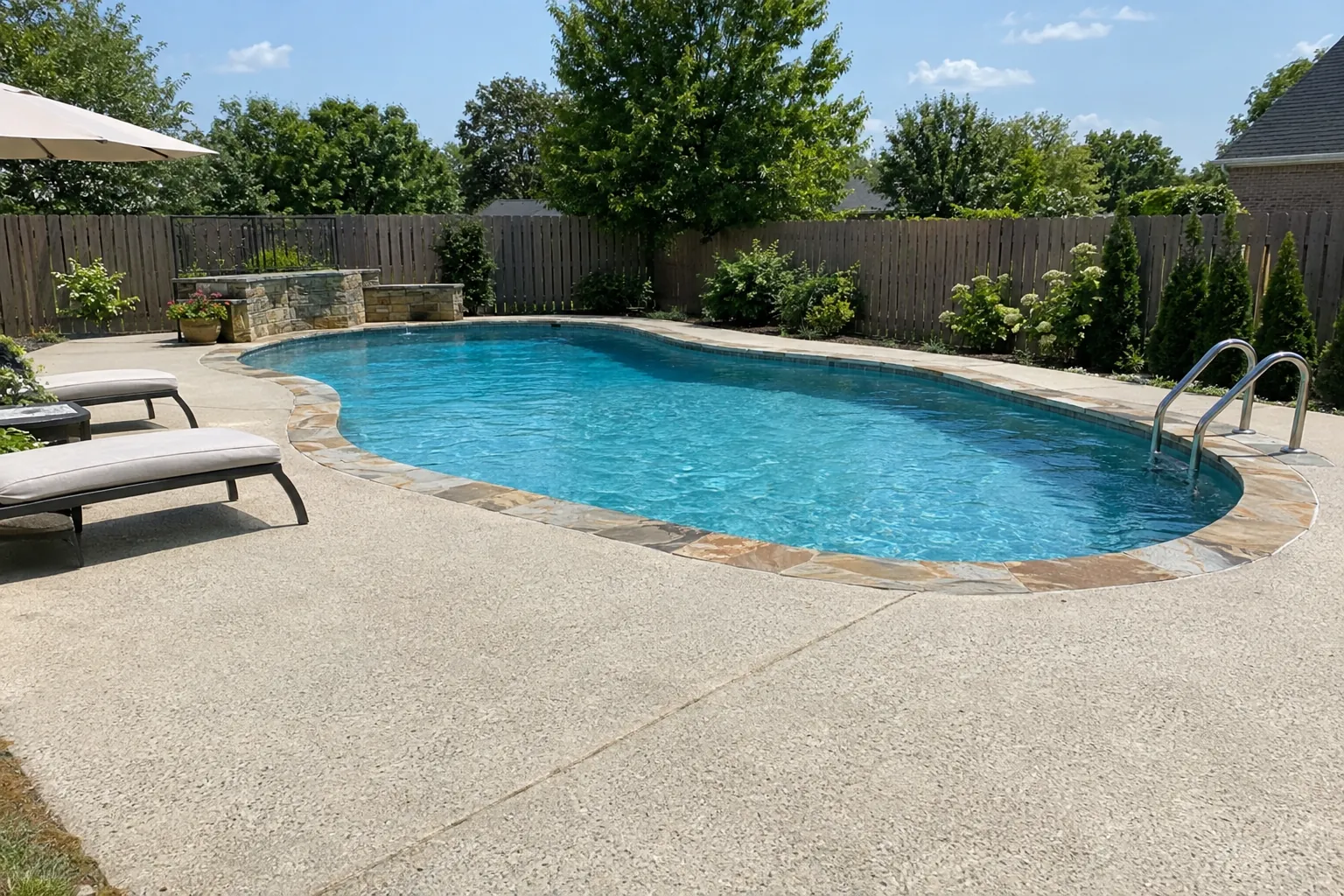
Clarksville Concrete Works builds new concrete pool decks, decorative deck finishes, pool deck repair, and pool deck resurfacing across Clarksville. A pool deck has to stay cool enough to walk on, grip when wet, drain away from the pool, and survive winters when the pool is closed.
New Concrete Pool Deck Installation
Layout and slope
The deck is poured on a compacted crushed-stone base around the pool coping, with reinforcement and a slope of about 1/8 to 1/4 inch per foot away from the water. Splash-out and rain drain toward deck drains or the yard instead of back into the pool. We plan room for loungers, a table, and a clear walking path at least 4 feet wide around the water.
The coping joint
An expansion joint between the coping and the deck, sealed with a flexible sealant, lets the pool shell and deck move independently and keeps water out of the gap. This joint is the single most common failure point on older Clarksville pool decks.
Working with your pool builder
On new pools, we coordinate with the pool contractor on coping height, plumbing and electrical runs under the deck, and the timing of the pour so the deck goes in after backfill has settled.
Pool Deck Finishes
Spray-texture cool deck
A thin acrylic or cementitious texture, often called a knockdown or "cool deck" finish, is applied over the slab. It stays noticeably cooler underfoot than plain or stamped concrete and adds grip.
Stamped concrete
Stone, slate, and wood-plank patterns around the pool, sealed with a non-slip additive. See stamped & decorative concrete.
Exposed aggregate and salt finish
Textured finishes with excellent traction for wet bare feet. A salt finish leaves small pits in the surface for grip without a rough feel.
Broom finish
The simplest, most affordable non-slip surface.
Concrete Pool Deck Repair
Pool decks crack, lift at the coping, and develop trip edges as the ground under them moves. Small cracks are routed and sealed, raised panel edges can be ground flush, and failed coping joints are cut out and resealed. Damaged sections can be saw-cut and replaced. See concrete repair.
Pool Deck Resurfacing
Older decks that are stained, rough, or flaking, but still structurally sound, can be ground, patched, and resurfaced with a new texture coat or overlay instead of torn out. Cracks are filled first, the coping joint is resealed, and the new surface can change the color and texture entirely. See resurfacing & sealing.
Heat, Chlorine, and Winter
Lighter colors and textured coatings reflect more heat. Pool chemicals and salt-water systems are hard on concrete, so decks should be sealed and resealed regularly. Before winter, keeping the coping joint sealed and the deck draining properly prevents freeze-thaw damage while the pool is closed.
Safety Around the Pool
Pool decks need slip-resistant finishes, steps with consistent risers, and clear walkways. If your pool needs fencing or gates to meet local barrier rules, plan the deck layout around post locations before the pour.